The Hidden History of Braxted Park: A Window into Britain’s Architectural Heritage
New research reveals the remarkable story behind Braxted Park's Georgian windows, their connection to Westminster Abbey and Cambridge University, and the extraordinary architectural legacy of Sir Robert Taylor.
Here at Braxted Park Estate, conservation is about much more than preserving our beautiful buildings and landscapes. It is about understanding the stories behind them, protecting their historical significance and ensuring that future generations can continue to enjoy and appreciate this remarkable place.
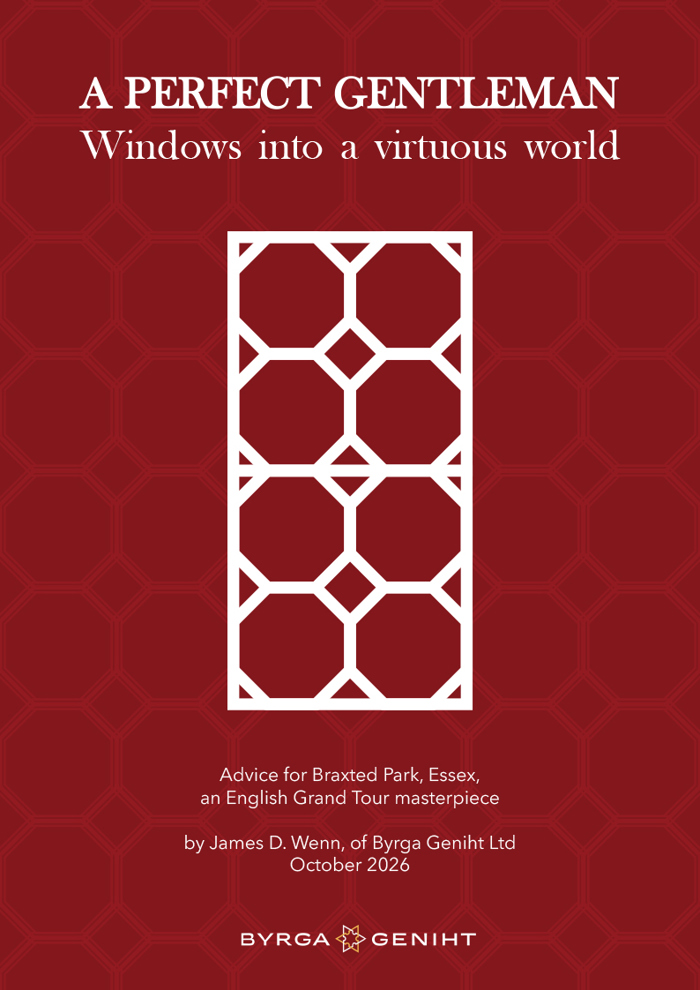
A fascinating new research report, A Perfect Gentleman: Windows into a Virtuous World, by architectural consultant James D. Wenn of Byrga Geniht Ltd, has shed new light on one of Braxted Park's most distinctive architectural features: its Georgian windows.
What might appear at first glance to be simply an elegant decorative design is, according to the research, part of a much deeper story connecting Braxted Park to some of Britain's most important architectural, academic and religious landmarks.
The Birthplace of a Georgian Architectural Signature
Braxted Park holds a particularly important place in British architectural history.
In 1752, Peter Du Cane Sr, a prominent Essex landowner, High Sheriff of Essex and Director of the Bank of England, commissioned the architect Sir Robert Taylor to undertake work at his country estate.
Remarkably, Braxted Park became Taylor's first country house project.
Taylor would go on to become one of the most significant architects of the Georgian period, responsible for important buildings across London and the English countryside. His achievements were such that his memorial in Westminster Abbey described him as belonging to the very highest rank of British architects.
It was here at Braxted Park that Taylor first introduced what would become one of his most recognisable architectural signatures: a distinctive window design featuring large octagons connected by smaller squares.
The design subsequently appeared in other celebrated country houses, including Harleyford Manor in Buckinghamshire and Barlaston Hall in Staffordshire.
Yet Braxted Park was where this architectural story began.
A Remarkable Connection to Cambridge
The research traces the origins of Taylor's window design to Corpus Christi College, Cambridge, an institution with longstanding historical connections to Great Braxted.
The parish church of All Saints, situated within the parkland of Braxted Park, has for centuries been associated with the college, which held the right to appoint its rector.
At Corpus Christi, the historic chapel featured an extraordinary geometric floor incorporating the same pattern of octagons and squares later used by Taylor.
The report explains how this celebrated design, preserved through successive rebuilding projects, provided the inspiration for the windows at Braxted Park.
It is a remarkable connection between an Essex country estate and one of England's oldest academic institutions.
From Westminster Abbey to Braxted Park
The story becomes even more intriguing when the research explores the possible symbolism behind the geometric pattern.
The report draws connections with the medieval Coronation Pavement at Westminster Abbey and the Westminster Retable, one of England's oldest surviving altarpieces.
Central to the interpretation is a geometric form known as the rhombic dodecahedron, a twelve-sided shape that can fit together with identical forms without leaving gaps.
According to the research, this geometry was historically associated with ideas of harmony, unity and the relationship between individuals within society.
The report also explores connections to garnet crystals, religious symbolism and classical philosophy, suggesting that Taylor's windows may have represented far more than an attractive architectural detail.
These interpretations offer a fascinating perspective on the intellectual and cultural influences that may have shaped Georgian architecture.
More Than Just a Beautiful Country House
For those who visit Braxted Park today, the estate's historic buildings, gardens and parkland provide an extraordinary setting.
But behind the beauty lies a wealth of history.
The research places Braxted Park within the wider story of the English Grand Tour, exploring how the country's great houses, universities and architectural landmarks reflected the cultural ambitions of their time.
It also highlights the significance of Braxted Park as an early example of Robert Taylor's country house architecture.
What makes this particularly special is that these architectural details remain part of the estate's character today.
The windows are not simply remnants of the past. They are an enduring connection to the people, craftsmanship and ideas that shaped Braxted Park nearly three centuries ago.
Conservation: Protecting Our Past for the Future
At Braxted Park Estate, we recognise the responsibility that comes with caring for a place of such historical importance.
Our approach to conservation encompasses not only the estate's natural environment, parkland and biodiversity, but also its buildings, architectural heritage and cultural history.
Research such as this helps us better understand what makes Braxted Park so special and why thoughtful conservation matters.
Every architectural feature has a story to tell. Every generation has a responsibility to protect those stories for the next.
We are delighted to share this fascinating research and hope it encourages visitors, historians and those with an interest in British architecture to look a little more closely at the extraordinary details of Braxted Park.
Discover the Full Story
For those wishing to explore the history in greater depth, the complete illustrated report examines the architectural, geometric and philosophical connections behind Sir Robert Taylor's distinctive windows.
A Perfect Gentleman: Windows into a Virtuous World
Advice for Braxted Park, Essex, an English Grand Tour Masterpiece
By James D. Wenn, Byrga Geniht Ltd | October 2026
[Download the Full Research Report (PDF)]
Our thanks to James D. Wenn and Byrga Geniht Ltd for their research and contribution to understanding the architectural heritage of Braxted Park Estate.